

“Skinny shaming” is not really a thing. Which is not to say that skinny people are never shamed, including for being skinny. But it is to say that the dynamics involved in skinny shaming are distinct enough from what goes on with fat shaming that a term which implies symmetry between the two, in the way skinny shaming does, obscures more than it clarifies.
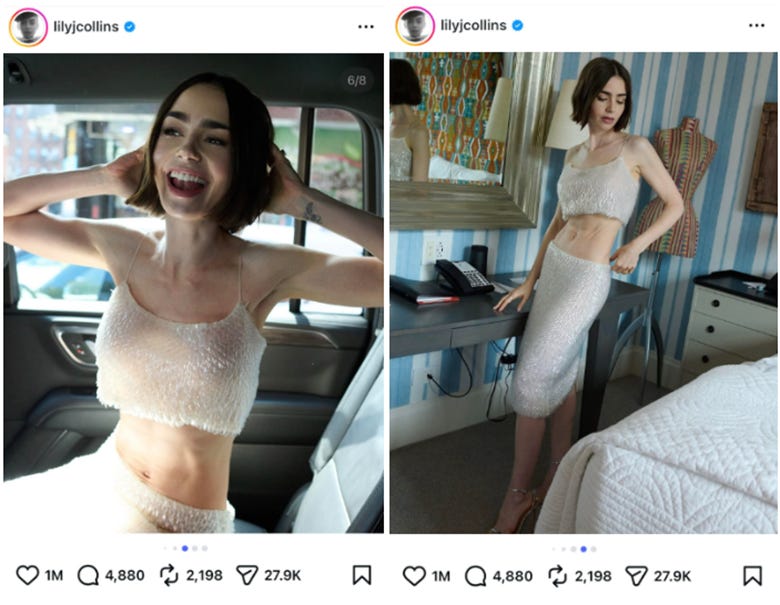
This came up for me a few months ago after Lily Collins put out a sponsored post with Vogue and Calvin Klein. The series of photos highlighted a shockingly concave mid-section, and generated a lot of very strong feelings. While some expressed delighted envy for her “abs” others expressed disgust, concern or anger.
Comment category 1: Aesthetic approval or disapproval
1 A) Delighted Envy: “You are a beautiful kweeeeeen how can I look like you hot, strong mama!!”
1 B) Aesthetic Disgust: “Ew!! Skin stretched over bones, how can anyone find this remotely appealing, please just kys”
Comment category 2: “Genuine” Concern
2 A) Concern *for Lily*: “I’m scared for you, I know you’ve struggled with EDs… please get help!”
2 B) Anger at Lily, motivated by Concern *for Society*: “I love you and I hate to comment on women’s bodies, but this is not ok - you are a role model to young girls and these images cause literal harm.”
Comment category 3: Commenters telling off other commenters
3 A) Reactionary backlash to aesthetically motivated disapproval: “OK so now we think a healthy, fit body is upsetting LOL, pfft, this is the predictable result of toxic body positivity!”
3 B) Attempted edification of those Concerned: “Hey there you self-righteous, self-appointed judges of the acceptability of women’s bodies! If you were *actually* a feminist, you would KNOW that it is NEVER ok to make a negative comment about a woman’s body!! Just let women LIVE!”
Personally, I think Lily looks underweight in these photos. I also think she very likely wants to look like that, i.e. very thin, and that the brands that worked on the shoot styled her to highlight her thinness. It’s also plausible to me that young girls who like her and see those photos might walk away with a slightly less healthy body ideal than they had before seeing them.
Taking it for granted, for the sake of argument, that she appears underweight, the question is: what is the appropriate response to such a post? Is criticizing Lily, or the brands working with her, for implicitly endorsing anorexia really just the other side of the coin of accusing a larger woman in a bikini of “glamorizing obesity”?
Is Lily “glorifying” anorexia? Or is she just a very thin woman posting a photo?
In her (in?)famous post, Question for the culture, Lana Del Rey complained about being impugned for “glamorizing” abusive relationships:
I’m fed up with female writers and alt singers saying that I glamorize abuse when in reality I’m just a glamorous person singing about the realities of what we are all now seeing are very prevalent emotionally abusive relationships all around the world.
Lana’s complaint asks us to distinguish artistic representation from actual endorsement. There’s no question that her music and image are influential, but she rejects the idea that she bears responsibility for the manner in which her viewers respond to them. While it’s hard to draw a bright line here, it seems reasonable to assert that “influencers” bear more responsibility for the outcomes that follow from what they actively endorse than they do for the myriad interpretations of, or behaviors inspired by, merely encountering their work. So… is Lily glamorizing extreme thinness? Or is she just a glamorous woman who also happens to be very thin?
A parallel debate plays out constantly in body positive spaces. You can find endless examples of larger women who’ve posted photos of themselves in a bathing suit, or some other relatively revealing outfit, only to be yelled at on the internet for “glorifying obesity”. A common response to this is to point out that in reality… these women are often just sharing photos of themselves living their life, making no claims at all about obesity. Sharing a photo like this, on my read, implies at most a lack of shame for your body, not a glorification of it.
I do think posting implies some sort of endorsement. I just don’t think it implies endorsement of the specific element which is perceived as problematic. Lana’s writing and performing songs about abuse doesn’t imply endorsement of abuse, it implies endorsement of her art. Likewise, posting a photo of yourself in a bikini doesn’t imply endorsement of your body, at least not in the sense of wanting to influence others to attempt to achieve it. Perhaps you’re endorsing the outfit, or the setting, or the memory being captured - the body itself may be incidental.
The same could be said about Lily. This was her body at the time those photos were taken. She didn’t tell people they should aim at it, the post isn’t paired with a guide on how to eat and exercise to look like her, if that’s what a viewer takes away is that really on her? And moreover, if she does have an eating disorder, does she therefore have a moral obligation to hide herself and her body as a result? Do brands have an obligation not to work with her because they deem her body unhealthy? Would the same logic apply to working with someone who had a body that was larger than the optimal healthy size? How strict would we expect these brands to be? Can they work with someone who’s only chubby? Or just a teensy bit underweight?
Asymmetric shaming
While there are several attributes which skinny shaming and fat shaming share, particularly the claim from some that the criticism is driven not by hate but by concern, I think there is a real difference between shaming Lily, or the brands working with her, for glorifying anorexia and shaming e.g. Lizzo for glorifying obesity. In the case of fat shaming, what seems to trigger outrage is less a perceived glorification of obesity than a belief that the person is not exhibiting enough shame. If you think shame is an effective incentive (at the margin) for maintaining a healthy body weight, then a larger woman showing her body without explicitly rejecting it feels threatening (A view I disagree with, as discussed here.).
While it is common to reject intentional weight loss within body positive spaces, it’s not common to recommend, or claim to aim at, intentional weight gain. Fat acceptance is about just that, *acceptance* of how your body is, not glorification or endorsement of a particular body type. This follows in part from the fact that gaining fat is really easy for most of us, it’s not something people typically have to try at.
The same is not true of extreme thinness. So when you see someone who is extremely thin it’s rational to assign a higher prior to the likelihood that they’ve intentionally made their body look that way. And that intentional effort can more plausibly be interpreted as implying endorsement.
Beyond the presumptive effort that Lily put into being thin, she was also (arguably) styled and posed to showcase her thinness. This, I think, is why these photos drew so much attention: to many viewers, Lily didn’t appear simply as a glamorous woman who happened to be thin. The images read more as a glamorization and endorsement of thinness itself. And if you’re publicly endorsing harmful behaviors, or at least the probable outcome of such behaviors, don’t you bear some responsibility for the associated impacts on fans and viewers? Even if Lily herself bears limited responsibility, especially under the assumption that she struggles with disordered eating, presumably the brands working with her can still be held to account.
The case for criticism
Overall, I think aiming some negative feedback at the brands involved is reasonable. Growing up in the ’90s and ’00s, the beauty ideal, at least in terms of body fat percentage, was often well below what is optimally healthy (and also well below the typical male ideal). The Kardashian-era shift toward an ideal of structured curves may not have been any more attainable, but in my view it was still a meaningful improvement, because the behaviors one would typically employ in pursuit of that ideal (lifting weights, fueling with protein etc.) were significantly healthier than those encouraged by the heroin chic era. Criticizing brands for promoting a return to extreme thinness seems justified in that context.
But beyond that, I’d argue that some negative feedback can also be genuinely useful, not just for young viewers or society at large, but also for Lily herself. Anecdotes about the onset of eating disorders often highlight early weight loss that’s reinforced by copious amounts of praise. Is it really better for Lily to see only comments about her “enviable abs” and none expressing concern?
Now personally, I’m not the type to spend my Instagram hours concern-trolling skinny women—I’ve got way too many cat videos to get through. But at a time when extreme thinness feels ascendant again, a post like this receiving only positive comments strikes me as a worse outcome than the pile on.
I guess my point is that while skinny shaming and fat shaming have some similarities, they differ in a meaningful way: the reasonable expectation of endorsement. With fat shaming, the criticism targets not so much glamorization, but rather a lack of shame. Simply existing in a larger body without explicit self-reproach is treated as dangerous. With extreme thinness on the other hand, the baseline assumption is that the person has actively pursued that body and therefore, to some degree, implicitly endorses it.
Blame for insufficient shame feels quite different to me than blame for perceived endorsement. And that’s why these phenomena don’t feel symmetric, because the sort of skinny shaming discussed here is, in a sense, criticizing someone for something they like about themselves, something they intentionally cultivated, while fat shaming is criticizing someone for having the body they happen to have while failing to display the “correct” amount of shame about it.
Oh myy, it's been so long! Great to have you back!
Firstly, great to have you back!
Secondly, sometimes I think we ought to revive the concept of noblesse oblige. Those of us who are wealthy/intelligent/influential have a duty to broader society to set a good example. Proudly parading your grotesquely ultra thin body is not really doing as such.
Thirdly, please can we have more of those group zoom discussions for paid subscribers 🙏🙏